

The Original Snap-Off Blade
Born in Osaka, Japan, OLFA transformed the way the world cuts.
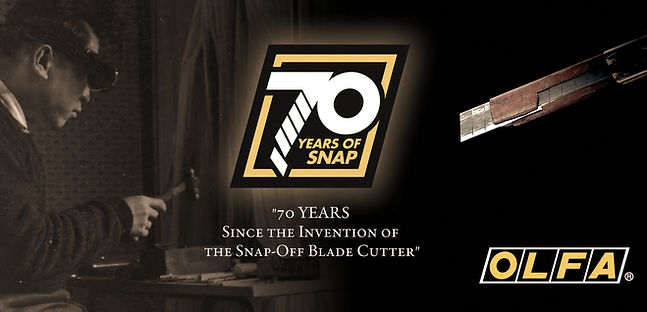
In 1956, founder Yoshio Okada invented the world’s first snap-off blade cutter, creating a simple idea that would go on to become a global standard.
Today, OLFA cutting tools are used by makers, craftspeople and professionals around the world - recognised for their sharpness, reliability and distinctive yellow design.

The Story Behind the Snap-Off
Blade
The idea for the OLFA cutter came from two surprisingly everyday observations.
While working in the printing industry, Yoshio Okada saw how commonly razor blades were used to cut paper. They were difficult to handle safely, and once the tip became dull, the whole blade often had to be discarded.
He also noticed that shoemakers would use pieces of broken glass to shave leather soles, breaking the glass again whenever they needed a fresh sharp edge.
Then came another inspiration: chocolate bars.
Okada remembered the segmented chocolate bars carried by American soldiers after the Second World War. The combination of these ideas led to something entirely new:
a blade designed to be deliberately snapped off section by section, revealing a fresh cutting edge every time.
In 1956, the first snap-off blade cutter was born.
A Small Invention That Became a Global Standard

Developing the blade took considerable experimentation.
Okada tested everything from the hardness of the steel and grinding precision to the spacing and depth of the snap lines.
One of the most important decisions was the blade's 59-degree snap angle.
That angle — along with the basic blade widths developed by Okada — later became the de facto international standard for snap-off blades.
The original prototype was approximately 13 cm long and 1 cm wide, with a new break line every 5 mm.
The First 3,000 Cutters Were Finished by Hand
At first, major manufacturers weren't convinced by the idea. A blade designed to break sounded completely wrong.
Okada eventually funded production himself and ordered an initial batch of 3,000 cutters from a local press factory. Unfortunately, many arrived poorly finished. Some were so uneven that the blades wouldn't even slide through the channels properly.
Rather than giving up, Okada and his team corrected them one by one using pliers, pincers and files. It took around three months to rework all 3,000 cutters by hand.
Those cutters became the first commercially produced OLFA snap-off knives.


The first commercialized model (one of the 3,000 pieces reworked)
Where Does the Name OLFA Come From?
The name itself also comes directly from the snap-off blade.
The Japanese expression associated with breaking a blade sounds like “OLHA”.
Because the letter H is not pronounced consistently in every language, the company replaced the H with an F.
And so:
OLHA became OLFA.
The name was created with international use in mind long before OLFA became the global brand it is today.
Why Is OLFA Yellow?
OLFA's unmistakable yellow wasn't chosen simply for branding.
When the first yellow OLFA models were introduced in 1967, tools were generally rather colourless. Okada wanted cutting tools to stand out clearly inside a toolbox, helping users notice them and handle them with greater care.
The colour chosen was a warm yellow inspired by the colour of an egg yolk.
That distinctive shade eventually became known around the world as OLFA Yellow.
From the Snap-Off Blade to the Rotary Cutter
OLFA didn't stop with the snap-off knife.
The MARU CUTTER, introduced in the 1970s, was OLFA’s early fabric cutter inspired by car tyres - a circular blade was clamped between rubber discs, and the rubber held the fabric in place while cutting. Its circular blade design later evolved into the world’s first Rotary Cutter in 1979. The dial engraving on the rotary blade is a remnant of the MARU CUTTER.
The rotary cutter later became particularly popular among quilters in North America and eventually became a standard cutting tool for fabric, craft and textile work.

How OLFA Cutters Are Made
From raw components to a precision cutting tool.
An OLFA cutter may look simple, but every tool is made from a carefully engineered combination of components — including the blade, stainless-steel blade channel, moulded handle and blade slider.
Each part reflects decades of experience in cutting-tool design.
For the OLFA L-5, one of OLFA's best-known heavy-duty cutters, the manufacturing process includes metal pressing, plastic moulding, component inspection, assembly, quality control and final packaging.
The finished tools are then shipped from Osaka to customers around the world.

OLFA at Pro Atelier Plus
We select OLFA tools for their combination of precision, dependable blade quality and practical Japanese engineering.
From cutters and specialist knives to replacement blades and accessories, explore our range of OLFA cutting tools for leathercraft, bookbinding, model making, design and workshop use.


